

NOOK is a purpose-driven social media platform designed to shift users from passive scrolling to meaningful connection. it aims to help users connect deeply, communicate intentionally, and use their time online with purpose, creating a calmer and more human social experience.
Problem Statement
Problem Statement
Problem
Users want to connect, communicate, and grow meaningfully through social platforms, but existing social media prioritizes passive consumption, algorithmic feeds, and surface-level interactions—leading to digital fatigue, shallow relationships, and unintentional usage.
Users want to connect, communicate, and grow meaningfully through social platforms, but existing social media prioritizes passive consumption, algorithmic feeds, and surface-level interactions—leading to digital fatigue, shallow relationships, and unintentional usage.
Design Goal
Design Goal
Design Goal
To design a social media experience that prioritizes people over content, encourages meaningful conversations, supports intentional usage, and promotes digital wellbeing instead of endless scrolling.
To design a social media experience that prioritizes people over content, encourages meaningful conversations, supports intentional usage, and promotes digital wellbeing instead of endless scrolling.
Design Principles
Design Principles
People First, Not Content-Highlight connections, not viral posts
Active Over Passive-Encourage conversation, co-creation, and participation
Intentional Usage-Let users define why they’re here (learn, connect, reflect)
Depth Over Validation-Replace likes with meaningful responses
Wellbeing by Design-Built-in time awareness, session limits, and mindful breaks
Transparency & Control-Clear visibility into usage patterns and feed logic
People First, Not Content-Highlight connections, not viral posts
Active Over Passive-Encourage conversation, co-creation, and participation
Intentional Usage-Let users define why they’re here (learn, connect, reflect)
Depth Over Validation-Replace likes with meaningful responses
Wellbeing by Design-Built-in time awareness, session limits, and mindful breaks
Transparency & Control-Clear visibility into usage patterns and feed logic

Secondary Research
Secondary Research
Secondary research reveals that most existing social media platforms are designed to maximize time spent, not the quality of interaction.
Secondary research reveals that most existing social media platforms are designed to maximize time spent, not the quality of interaction.
Passive consumption over participation- Secondary research reveals that most existing social media platforms are designed to maximize time spent, not the quality of interaction.
Passive consumption over participation- Secondary research reveals that most existing social media platforms are designed to maximize time spent, not the quality of interaction.
Shallow, validation-based engagement- Likes and reactions dominate,reducing space for thoughtful conversations and authentic expression.
Shallow, validation-based engagement- Likes and reactions dominate,reducing space for thoughtful conversations and authentic expression.
Algorithm-driven loss of control- Feeds prioritize viral content over personal relevance, making users feel disconnected from their intent.
Algorithm-driven loss of control- Feeds prioritize viral content over personal relevance, making users feel disconnected from their intent.
Declining digital wellbeing- Unstructured usage contributes to fatigue, comparison, and stress rather than meaningful connection
Declining digital wellbeing- Unstructured usage contributes to fatigue, comparison, and stress rather than meaningful connection
Competitive Analysis
Competitive Analysis
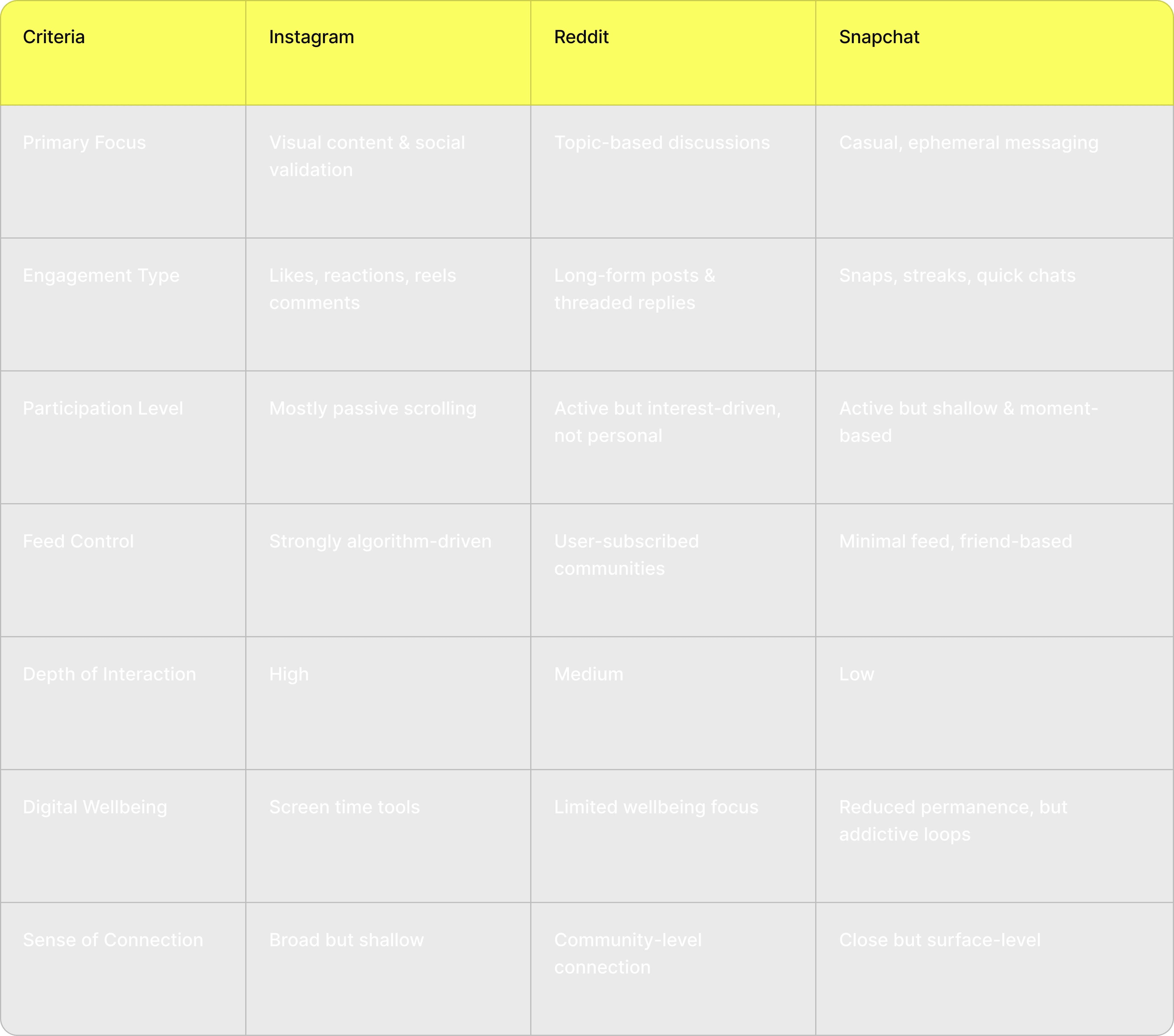
primary Research
primary Research
survey (Quantitative Research)
survey (Quantitative Research)
survey (Quantitative Research)
I did an online survey to observe similarity in what the potential user wants. Some of the questions i asked are below-
I did an online survey to observe similarity in what the potential user wants. Some of the questions i asked are below-


Quantitative Research insights-
Quantitative Research insights-
Quantitative Research insights-
Most users spend 1–4+ hours daily on social media, yet report only moderate value from that time.
Passive scrolling is the primary activity, while active engagement and learning remain secondary.
Social interactions are rated 2–3/5, with deep conversations happening rarely or only sometimes.
A majority of users feel exhausted after social media use, indicating emotional and cognitive overload.
Most users prefer platforms that limit endless scrolling and encourage intentional sessions.
Users show high interest (3–5/5) in real-time shared activities and are open to replacing likes with deeper interaction methods.
Most users spend 1–4+ hours daily on social media, yet report only moderate value from that time.
Passive scrolling is the primary activity, while active engagement and learning remain secondary.
Social interactions are rated 2–3/5, with deep conversations happening rarely or only sometimes.
A majority of users feel exhausted after social media use, indicating emotional and cognitive overload.
Most users prefer platforms that limit endless scrolling and encourage intentional sessions.
Users show high interest (3–5/5) in real-time shared activities and are open to replacing likes with deeper interaction methods.
Information Architecture
Information Architecture

Navigation
Navigation
Primary Navigation (Bottom Nav – 5 tabs)
Home
Discover
Wellbeing
Post
Profile
Primary Navigation (Bottom Nav – 5 tabs)
Home
Discover
Wellbeing
Post
Profile
Secondary Navigation (Within screen)
Home → Filters (People / Activities), Messages, Notification
Groups → search, filters
Discover → Purpose filters (Learn, Reflect, Support), events filters
Secondary Navigation (Within screen)
Home → Filters (People / Activities), Messages, Notification
Groups → search, filters
Discover → Purpose filters (Learn, Reflect, Support), events filters
Tertiary Navigation (Contextual)
Conversation actions (voice reply, reflect, save)
Space tools (polls, timers, prompts)
Wellbeing controls (limits, reminders)
Tertiary Navigation (Contextual)
Conversation actions (voice reply, reflect, save)
Space tools (polls, timers, prompts)
Wellbeing controls (limits, reminders)
Key User Journeys
Key User Journeys
Journey 1: Start a Meaningful Conversation
Home → Select person → Conversation prompt → Voice/text reply → Reflective follow-up
Journey 1: Start a Meaningful Conversation
Home → Select person → Conversation prompt → Voice/text reply → Reflective follow-up
Journey 2: Participate in a Shared Group Activity
Shared Spaces → Join activity → Live interaction / async contribution → Completion feedback
Journey 2: Participate in a Shared Group Activity
Shared Spaces → Join activity → Live interaction / async contribution → Completion feedback
Journey 3: Purpose-Driven Discovery
Discover → Choose purpose → Curated content → Save or share with context → Session end
Journey 3: Purpose-Driven Discovery
Discover → Choose purpose → Curated content → Save or share with context → Session end
CONCLUSION
CONCLUSION
NOOK isn't really about creating another social media feed. The core idea is to change the interaction model from consume → react → scroll to something closer to choose → participate → connect → reflect.
My biggest takeaway from this project was that solving a UX problem isn't always about adding more features. In this case, it was about reconsidering what the product should optimize for in the first place.”
NOOK isn't really about creating another social media feed. The core idea is to change the interaction model from consume → react → scroll to something closer to choose → participate → connect → reflect.
My biggest takeaway from this project was that solving a UX problem isn't always about adding more features. In this case, it was about reconsidering what the product should optimize for in the first place.”
